Thor bu - Curiosia Indo-Tibetica

Textual and visual odds and ends from India, Tibet, and around.

My Photo
Name:
Location: Kolozsvár/Cluj, Budapest, Oxford, ibi ubi

Thursday, April 28, 2011

JA 298/2

The latest online volume of the Journal Asiatique is full of goodies. To wit:
  • pp. 389-420 Koichi Shinohara, "The All-Gathering Maṇḍala Initiation Ceremony in Atikūṭa's Collected Dhāraṇī Scriptures. Reconstructing the Evolution of Esoteric Buddhist Ritual."
  • pp. 421-493 Isabelle Ratié, "Le non-être, une preuve de l'existence du Soi? La notion d'abhāva dans la philosophie de la Pratyabhijñā."
  • pp. 535-548 Christopher I. Beckwith and Michael L. Walter, "On the Meaning of Old Tibetan rje-blon during the Tibetan Empire Period."
  • pp. 549-571 Nathan W. Hill, "Personal Pronouns in Old Tibetan."
I especially enjoyed reading about the new interpretation of rje blon, something that sounded 'scratchy' back in the days when we read Old Tibetan inscriptions.

Labels: , , , ,

Monday, October 11, 2010

Of the sons of donkeys and sows (a note on bureaucratic vulgarity)

Perhaps because of having dealt with so many wonderfully absurd bureaucratic situations Thor bu loves a bit of vulgarity in official documents. Apparently those good old Biharis (and Tibetans, on which a bit later) also loved a non-veg joke in their documents. This image comes from a grant dating to the early 13th century. A local king, the rather nebulous Aśokacalladeva, and/or his ministers built a small vihāra and left some endowments. The language of the document is pretty horrible. If you want to read more about it I suggest you download Epigraphia Indica 12. There are several other publications on this inscription, but unfortunately they are not available to me at the moment.

If you are reading Tsukamoto's Indo bukkyo himei no kenkyu ('A Comprehensive Study of the Indian Buddhist Inscriptions') you will perhaps get excited at the sight of one Kashmiri Abhayaśrī being mentioned. Unfortunately he is not. I still can't figure out what the name of Kashmiri fellow is, but I'm willing to wager a good bottle of wine that it is not Abhayaśrī.

Back to the image. Here is the bigger picture:


Apparently those good old Victorian gentlemen did not share the sense of humour of the people they were studying. Here is the same inscription in Sir Alexander Cunningham's Mahābodhi:

Notice the difference? Indeed, no more unlawful carnal knowledge between... but what are they? Well, we could argue about it, but I'm pretty sure it is a donkey and a sow (or more precisely a wild boar sow). But it's not because I'm so good at zoology; I could not tell you the difference between a boar and a badger (whatever those are). It's because the - I think rather well-executed - sketch is a somewhat unusual representation of an imprecation, which is, however, almost standard at the end of land grants. An inscription dating from 32 years later from the same location says:

vaṃśe madīye yadi ko 'pi bhūpaḥ
śiṣṭo 'thavā duṣṭataro vinaṣṭaḥ |
vyatikramaṃ cātra karoti tasya
tātaḥ kharaḥ sūkarikā ca mātā ||
"And should any king of my lineage,
be him learned/superior or wickedly damned,
violate [the terms of] this [donation], his
father is a donkey and his mother a sow."

So, what the image is saying is: 'I gently remind you to respect this here donation' (take that, semiotics!). Other standard verses, more common on Pāla grants, promise rebirth as a worm in excrement. Why can't we have things like this on our contracts? [sigh]

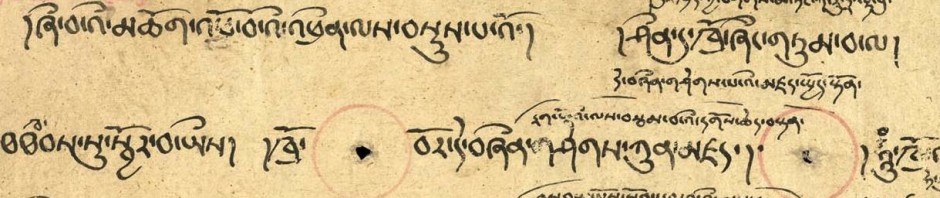
What about the Tibetans? Well, I came across this image some time ago in here.

I even remember having somehow deciphered some of the writing under the smudge, but I lost the higher resolution images some time ago. Maybe you will have more luck. The young scribe no doubt expressed how he felt about scribbling for the zhang blon, or for the other chap, who had nothing better to do but bother him with dictating a letter about how his yearly crops went on what I imagine to have been a sunny afternoon.

Labels: , , ,

Thursday, September 23, 2010

Kīli kīlaya


viditam astu bhavatām that Rob Mayer and Cathy Cantwell have opened a blog with a rather fascinating first post and hopefully many more to come.

Labels: , , ,

Monday, October 05, 2009

Vajrayāna off-limits in two apologetic works

After a long silence and too many bzhad gad entries let us look at two fascinating little works hiding deep in the bowels of the Tengyur.

The section between Tōh. 3707 and 3729 houses what I informally think of as the 'essayistic' part of the Canon. Some works here are better known than others, with famous items such as the Tattvasiddhi (a new and complete edition by Toru Tomabechi, forthcoming), the Gurupañcāśikā (of which we now have a new manuscript, see Szántó, forthcoming), and Jñānaśrī's *Vajrayānāntadvayanirākaraṇa (recently studied by Taiken Kyuma and Ryugen Tanemura in Genesis and Development of Tantrism). But there are other works here which merit the same attention, such as the oft-quoted Nayatrayapradīpa, the *Triyānavyavasthāna of Ratnākaraśānti [?], and the *Yoganiruttaratantrārthāvatārasaṃgraha of Śraddhākaravarman.

And there are yet others which are read only on rainy days such as these two: the *Tattvasārasaṃgraha (TSS) of *Dharmendra (Tōh. 3711), and the *Mantranayāloka (MNA) of Mtho-btsun btso-yags (Tōh. 3710). Note the inversion in cataloguing, which suggests that the Tibetan compilers haven't read them with due attention either. The two obviously constitute a pair, since the author of the MNA clearly states that he wrote in defense of a claim made by his master in the TSS. So to get the timeline right: we had *Dharmendra write his TSS, which became controversial, and his disciple wrote the MNA to straighten out things. Both works were translated by Rin chen bzang po (the TSS with Janārdana, the MNA with Padmākaravarman). Hence Mtho-btsun btso-yags is either earlier or contemporary with Rin bzang, and *Dharmendra preceded both. However, I cannot help suspect that master and disciple wrote much earlier, perhaps a century or so, for reasons I will give below.

What was *Dharmendra's controversial claim then? You have to read through the work to find it. The TSS flows neatly in a Q/A format discussing several intriguing questions about the Mahāyāna. The conscientious objector asks at the end (98a1-99a2): surely, if the Buddha said that the Vajrayāna is the most efficient way for enlightenment, why is it that you do not speak about it here?

*Dharmendra does not deny that the way of Mantras exists as a valid revelation. Instead, he states that there are simply no suitable people in our day and age to practice it. The Buddha knew this very well and he actually prohibited *lokottara (understand, antinomian) practices. To this effect he quotes an obscure work, the Gsang sngags kyi theg pa tshul:

| shes rab de ni mi shes {99a7} shing |
| ngar 'dzin dri mas spags pa rnams |
| de yi 'jig rten 'das spyod pa |
| dmyal bar 'gro ba kho nar zad |

These people do not know wisdom and
mix [their practices] with the defilement of egoism–
their practices 'transcending this world'
result in nothing else but going to hell.

And again, from the same work:

| thabs bzang rnam par spangs nas ni |
| 'gal ba'i dam tshig la sogs pa |
| gang zhig gzhan du byed pa dag |
| de ni {99b1} ngu 'bod dag tu 'tshed |

Those people who behave perversely,
who turned away from good practices,
and adopted contradictory vows and the such
will roast away in the Howling Hell (raurava).

| dper na 'di na rab 'bar mer |
| rtsva dang shing la sogs pa'i tshogs |
| bcug pa thal ba nyid 'gyur gyis |
| slar ni rab tu skye mi 'gyur |

Take as an example a roaring fire:
heaps of grass, wood, and the such
are reduced to ashes when thrown in,
and will never resume their form.

| de bzhin de nyid rnam bral bar |
| shin tu rmad byung las byed pa |
| ji srid nam mkha' gnas par du |
| shi nas {99b2} dmyal bar 'gro bar 'gyur |

In the same way, those who are bereft of Truth
and [adopt] these strange practices,
will die and and go to hell
for as long as the sky abides.

There are two more quotes more or less to the same effect. *Dharmendra closes his work saying that since the Buddha prohibited such practices, he will follow suit and not speak a word about Vajrayāna.

Well, it's easy to see how this succinct treatment of such a sensitive topic could have elicited outrage. And elicit outrage it did. Enter Mtho-btsun btso-yags (sometimes spelt mtso-yags, tso-yag):

| dus kyi bdag nyid ngan pa dang |
| 'gro ba 'ang skal ba med pa dag |
| gzigs nas bdag gi bla ma yis | {76a6}
| gsang sngags tshul bshad bkag pa yin |

My master saw that times are bad
and people are unqualified,
hence he prohibited explaining
the way of Mantras.

| 'di ltar de nyid kyis mdzad pa'i |
| De nyid snying po bsdus par ni |
| de[r] ma bshad pa'i rigs pa dang |
| dgongs pa yang ni bstan pa yin |

And he did so in his work,
the Tattvasārasaṃgraha.
I shall now teach the unstated but intended
meaning and the reasoning behind [this claim].

| gang yang blo dman kha cig ni |
| der des ma rtogs pa nyid dam |
| phrag dog yin par {76a7} dogs byed cing |
| rmongs pa yis kyang de brnyas byed |

Some people of low intelligence
either did not understand what he said there,
or they were just jealous and thus objected,
and deluded ones even spoke ill of him.

| de spang sdig pa'i me nang du |
| phye ma leb ltar ji srid ni |
| ltung bar ma gyur de srid du |
| de skyob pa la bdag 'bad do |

Our endeavour then is to refute this
and save them from the fire of sin,
lest they should fall in it like a moth.

The work goes on to criticize in detail these practices he and his master found unacceptable. The verses drip with sarcasm which in itself makes it a pretty enjoyable read, but what is most interesting for our immediate purposes is the prima facie view he quotes as reported by his adversaries:

«'on te de nyid rnal 'byor pa |
| bdag cag la ni kha zas {76b5} dang |
| spyod lam sogs kun ci dga' bar |
| Rnal 'byor rgyud las skyob pas gnang |

But for us, yogins of the Truth / true yogins,
the Lord allowed in the Yogatantras
to take food, adopt conducts,
and so on as we please.

«de yang 'di ni gsal nyid du |
| Zla gsang thig le la sogs las |
| rnal 'byor ba yis mi bya ba |
| ci yang med ces gsungs pa yin |

This is clearly stated in texts
such as Guhyendutilaka, to wit:
there is nothing that a yogin
is not allowed to do.

Well now, this is intriguing. Yogatantras and the Guhyendutilaka to justify antinomian practices? Why not yoginītantras? It doesn't get any more antinomian than that! And where have we seen this combination before? Yes, the prize goes to anyone who said Tattvasiddhi first. Could we be looking at the same environment?

The continuation of the rebuttal is just as exciting, but this is pretty much all I wanted to say to whet your appetite for reading these two texts. A couple of more interesting points to be noted: one of the punishments the author of the MNA has in view is that of temporal rulers–

| phyin ci log gi las byed na |
| re zhig 'jig rten smod byed la |
| de bzhin rgyal po la sogs kyi |
| chad pas rmongs pa 'jig par 'gyur |

If you perform perverted deeds
you will not only elicit scorn from the public,
but your delusion is sure to be cured
by the punishment of the king and others.

And just to give you an idea about the author's arguments:

| bkres skom tsha grang rmugs pa dang |
| gnyid sogs kyis rab gdungs gyur pa |
| snang na de ru khyod kyi ni |
| dngos po med pa gang du song |

[Everything is immaterial you say,]
but when hunger, thirst, hot, cold,
depression and torpor hit you
where is your 'immateriality'?

To wrap up, it should also be noticed that the MNA is not quite so dismissive as his master's work. He simply calls yogins to examine their attitude and their practices better.

PS: all translations were made ad hoc and without much thought. Suggestions are welcome.

Labels: , , , , , , , ,

Wednesday, June 10, 2009

An inscription from Spu hreng

Sam of earlytibet fame posted a very interesting article recently. In the comments thereon I suggested that the text was defaced in order to 'recycle' the text. Today however this interesting little inscription came to my attention which should perhaps be added to the argument, although this defacement (if it is one) is of an entirely different nature.

It has been some years that Precious Deposits has been published and shame on me for not browsing through its five volumes earlier. Volume one (amongst many other fascinating things) has a picture of this Avalokiteśvara statue (p. 173, sorry about the quality; I could not take out the book from the library so a bad photocopy-scan will have to do). According to the caption the statue was found in Zhi bde village in Spu hreng county.

Then there is this dedicatory inscription (p. 172) with all kinds of good wishes from the donor. I will not transcribe it since it is quite legible in the book.

But here is the interesting part: who is the donor? The right side says Seng ge zhang chen po 'Bro(?) khri(?) brtsan sgra||(!) mgon po rgyal, (?) meaning that you can barely make out the letters. The other side has a slight variant for the name: zhang 'Bro(?) khri(?) brtsan sgra mgon po rgyal. Notice how the clan name 'Bro and the khri are almost illegible in both cases. Furthermore, is khri some kind of pretense of royalty (at any rate, is that what the vandal thought)? But then why is he calling himself zhang and zhang chen po?

Below you will find the names. I might just be paranoid, but it is highly unlikely that someone vandalizes two sides of an inscription in exactly the same places where the donor identifies his clan and possibly arrogates to himself the royal khri. Quite clearly, this guy had a problem with the 'Bros. And who would those be? Well, who did not have a problem with them?

Suggestions/comments are highly welcome.

Labels: , , , ,

Tuesday, June 02, 2009

Bsam yas rdo ring

The attractive new coating. I guess it makes it a little bit more legible but they should have used some pink and neon green I feel.

Labels: , , ,

Thursday, May 28, 2009

Canons for all

Thanks to Dan for pointing out this blog entry. In short TBRC has decided to make canonical collections free for all to view. Their laudable decision will be followed by a string of lawsuits from Tibetologists all over the world (causing endless sleepless nights, exhaustion, spectacular breakdown of their non-canonical social life, etc.) However, for the time being many thanks are due.


Labels: , ,

Tuesday, May 26, 2009

Yum bu bla mkhar

Chances are that you will arrive quite exhausted to the Yum bu bla mkhar. Do not be fooled by the approach, which is very cleverly constructed. If yours truly managed to be at the gate in thirteen minutes from the bottom of the hill, you will certainly do better.

Here is a close-up of this magnificent building. Some fifteen hundred years ago Lha tho tho ri was taking his afternoon stroll up there just to be knocked on the head by some sūtra.

That's the newly constructed bus station with the usual tourist rip-offs such as one yuan for the bathroom (raw silk sanitary towels and complimentary Chanel no. 5 included).

The rest of the view is, however, breathtaking (quite literally). The Yar lung valley is lush. It was for the first time I really understood the eulogy of P.t. 1026.

Note the walled area on the left. According to legend this was the first parcel to be worked upon after the self-planting, self-growing grains were gone.

The small stele marks the spot of the first settlement created by the sons of the good monkey and the brag srin mo.

Yonder a small chapel holding the throne of Atīśa.

A view best enjoyed with good friends.

The old man will insist that you offer bsangs to the gods. Don't resist, he's very nice.

Labels: , ,

Friday, April 24, 2009

The 'Serampore' Dictionary


Google has digitized the pre-Csoma dictionary which was not widely available until now. Very entertaining. Note that the fonts are the same as used in Csoma's works.

Speaking of Csoma: here is a new archive (for the time being only in Hungarian) containing his complete works and loads of related material.

Labels: , , ,

Friday, March 06, 2009

Sakya resource center


The good people in Hamburg put up another very interesting and promising site: The Sakya Resource Center.

Labels: , , , ,

Thursday, March 05, 2009

In praise of Yamāri and Cāmuṇḍī (addendum)


In a previous note I said that the author of the acrostic about Yamāri might be the first Dalai Lama. I have now had the opportunity to consult his collected works. The work can be found on pp. 304-306 in vol. 6. (and the verses on Cāmuṇḍā follow thereafter). The blockprint version also has verses for Ka, Kha, Ga, and Nga, hence this is an omission in the Mongolian manuscript. Thus:

hūṃ

kā la rū pa rab brjid drag po'i sku |
kha nas khrag 'dzag mi mgo'i 'phreng ba yi |
ga sha rab 'phyang mi bzang bdud dpung gi |
nga rgyal dregs pa 'joms pa khyod la bstod ||

It is a bit surprising that the Mongolian scribe left this out but there you are. Never trust a scribe. Especially when he left out the first verse of the second hymn as well. Thus:

bhyauḥ (bhyo)

ma skyes mi 'gag chos dbyings klong yangs nas |
ma hā kā li srin mo khros pa'i sku |
ma rungs 'dul phyir rtse gsum thod khrag 'dzin |
ma mo chen mo Tsā mu ṇḍi la bstod ||

NB: the 'sample preview' allowed freely by the TBRC covers both works.

Labels: , , , , , ,

Monday, March 02, 2009

In praise of Cāmuṇḍī

And here is the second part of the manuscript with the praise of Cāmuṇḍī, where all quarter-verses begin with 'ma'.

ma he'i gdong can gshin rje' dga' ma khyod ||
ma rungs dgra la kha gdangs mche ba gtsigs ||
ma lus btud (bdud) kyi srog gcod bshan ba mo ||
ma yengs bstan pa'i bsrung ma'i khyod la bstod ||

ma gcig 'dod pa'i khams la dpang bgyur ma (dbang 'gyur ma) ||
ma mo mkha' 'gro sde brgyad 'khor dang bcas ||
ma mo'i dal yams la sogs chos bphrul ('phrul) gyis ||
ma tul ('dul) gtul (gdul) dka' 'joms ba khyod la bstod ||

ma bcos (3r) rang bzhin dag pa'i chos kyi dbyings ||
ma rtogs bdud kyi chos 'phrul ci byung yang ||
ma chen khyod kyi ming nas bos pa'i tshe ||
ma g.yel myur du byon lam mthu rtsal skyang ||

ma rungs rnams la rab tu khros gyur kyang ||
ma ltar rtse bas bstan 'dzin skyong ba khyod ||
ma sring chung ma bran ma'i tshul bzung nas ||
ma bskul bar yang mthun ba'i las kun bsgrubs ||

ma nor lam mchog ston pa'i bla ma dang ||
ma rig mun sel rgyal pa'i bstan ba la ||
ma dang log bar bgrub pa'i gong dang bgegs ||
ma bsgrub ba rnams chos gyi dbyings su sgrol ||

(3v) ma lus 'gro ba'i don du rnal 'byor ngas ||
manydzu gho ṣa'i go 'phang dam pa de ||
ma thob de srid nag mo chen mo khyod ||
ma g.yel ma g.yel 'phrin las tshul bzhin sgrubs ||

ma mo chen mo bstod cing bskul bas bdag ||
ma rig 'khrul pas bskyed pa'i 'khor pa 'de ('di) ||
ma stongs bar du bstan pa 'dzin pa la ||
ma hā kā lis rtag tu grogs byed shog ||

ma mo chen mo tsa mu ṇti la bstod pa 'de ('di) ni || dge slong Rdo rje 'dzin pa Dge 'dun grub pa dpal bzang pos | dpal byang chub chen po'i dben nas (gnas) theg chen pho brang du spyar (sbyar) ba'o || bkra shis par gyur gchig (cig) | sarba mga laṃ (mangga laṃ) |||

Labels: , , , , ,

In praise of Yamāri

While writing on the 'turtle manuscript' yesterday, I came across this old input of another manuscript from my humble collection. Maybe there is something in this turtle divination, since I thought I lost this file long ago. The ms. contains two praises, one for Yamāri and one for Cāmuṇḍī. The colophon attributes them to Dge 'dun grub, who is probably the first Dalai Lama. Since I am away from my TBRC access, I could not check this. The poem is in fact an acrostic which spells out the Tibetan alphabet from Ca to A (no idea why Ka-Nga is missing) plus two lines signing off with stating the purpose of writing the poem. If this is the first Dalai, then the inspiration probably came from his master, Tsong kha pa, who also wrote such poems, one of them a notoriously difficult piece where each line starts with A - lots of obscure words in the dialect of Amdo.

chos rgyal Gshin rje' rgya mtshos brgyan ba 'bul ma mo chen mo
Tsa mu ṇti la bstod ba zhes bya ba bzhugs so | | (1v)

ca cos che ldan rdo rje'i glu dbyangs dang ||
cha shas yongs su rdzogs pa'i gtor ma ni ||
ja chang phud dang dgra bgegs sgrab pa'i sha ||
nya sha khrag zhag rgya mtshos brgyan ba 'bul ||

Arias of the thunderbolt accompanied by clamor,
Bali-offerings spotless, with all their parts intact,
Choice tea and liquor, enemies' flesh in piles,
Donned in seas of fish, blood and fat - all this I offer.


ta thā ga ta'i bstan la gnod byed pa'i ||
tha chad dgra bgegs rtul du rlog pa dang ||
da nas bzung ste rnal 'byor bdag cag gi ||
na rga 'chi ba'i 'jigs pa 'joms la bstod ||

Enemies hurting the Tathāgata's teaching,
Foul rivals, impediments - brush them all away!
Grant us, praising yogins, from this day onwards
Health, youth, immortality, and escape from fear.


pa ba sangs ltar rab dkar mche pa gtsigs ||
pha rol 'joms pa'i spyan rtsa glog ltar 'khyug |
ba spu dus mtha'i me chen 'bar ba yis ||
ma lus bgegs dpung bsregs pa khyod la bstod || (2r)

[and so on, you get the idea]

tsa mu ṇti sogs ma mo kun gyi bdag ||
tsha zer rab tu rgyas pa'i gzi brjid can ||
dza zhes 'phrin las bsgrub la gos pa'i tshe ||
wa skyes lta bu'i bgegs 'joms khyod la bstod ||

zhwa ltar 'byung bo kun gyis spye (spyi) bos bsten ||
za byed ma he khros pa'i zhal bdangs shes ||
'a 'ur ngar ngar sgrog bas sa chen g.yo ||
ya las skyes pa'i thod dbyug 'dzin la bstod ||

rwa dang rmig pa rno ba'i ma he dang ||
la la rlu nag tshub ma zhon pa'i 'khor ||
sha ka li dang gshin rje' mas sogs ||
sa gsum 'byung po'i 'khor gyis bskor la bstod ||

ha ha drag tu bzhad ba'i dpal (2v) yon can ||
A rghaṃ la sogs mchod ba bzhes nas kyang ||
dpal ldan Gshin rje'i gshed kyi spyan snga ru ||
zhal bzhes dam bcas g.yel pa med par mdzod | |

Labels: , , , , ,

Speaking of turtles

Turtles are the talk of town. Here is one more handbook from my collection which once helped the good people of Mongolia find their lost things with the help of the friendly local lama. Apparently Inner-Asians lost their things quite frequently and have been doing so at least since Tibetans came to Tunhuang. There are doubtless hundreds of such manuscripts in specialized libraries. And if you are a lama, it's good to know another lama with such a manuscript, since you never know when you might lose yours.


Labels: , , , ,

Wednesday, October 29, 2008

Life and Works of rNgog Blo ldan shes rab (1059–1109)

For some misterious reason Ralf Kramer's book on rNgog lo is now available online. Thanks to Y.B./rten for the tip!

Labels: ,

Wednesday, October 22, 2008

TibSkrit 2008


It's a bit difficult to find if you're not looking for it. Go to the great blog, tibeto-logic. Then scroll down until you find this cat on the right side. Above it a link: Tibskrit 2008. And while you're there, read the new stuff on Pha dam pa.

Labels: , ,

Tuesday, October 21, 2008

Co ne bla ma online


A subproject of the good people of the ACIP have released scans of the complete works of Co ne bla ma grags pa shes grub, a famous master from Eastern Tibet. Personally I prefer the 'letter stack' download, this makes a pdf on letter paper size fitting as many folios as possible on a page.

Labels: , , ,